GeForce RTX 3070 Ti & GeForce RTX 3060 share many similarities, but there are also important differences, such as quality, performance, features, design, and connectivity. If you want the best one between them, I Would recommend the GeForce RTX 3070 Ti rather than the GeForce RTX 3060.
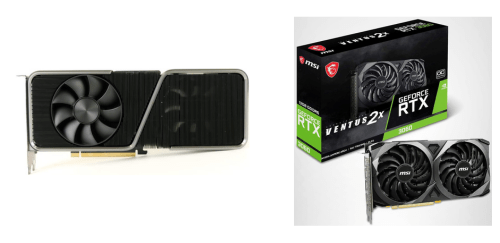
Why Do I Recommend The GeForce RTX 3070 Ti?
- The GeForce RTX 3070 Ti features 6144 CUDA cores for substantially higher parallel processing performance in modern games and GPU-accelerated workloads, while the GeForce RTX 3060 uses 3584 CUDA cores.
- GeForce RTX 3070 Ti comes with GDDR6X memory for much faster data transfer speeds that improve high-resolution gaming and ray-tracing stability, whereas the GeForce RTX 3060 uses GDDR6 memory.
- It includes a 256-bit memory bus to deliver significantly higher memory throughput for texture-heavy and open-world games, while the GeForce RTX 3060 uses a narrower 192-bit bus.
- The GeForce RTX 3070 Ti supports 608 GB/s memory bandwidth for smoother performance at 1440p and 4K resolutions, while the GeForce RTX 3060 operates at 360 GB/s.
- GeForce RTX 3070 Ti features 48 second-generation RT cores to handle more complex real-time lighting and reflections with less performance loss, whereas the GeForce RTX 3060 includes 28 RT cores.
- It comes with 192 third-generation Tensor cores for faster DLSS upscaling and improved AI-assisted frame generation, while the GeForce RTX 3060 has 112 Tensor cores.
- GeForce RTX 3070 Ti delivers higher FP32 compute throughput to maintain stronger frame consistency in demanding AAA titles, whereas the GeForce RTX 3060 provides lower raw shader performance.
Maybe the GeForce RTX 3060 price can make you comfortable because it’s a little bit cheaper than the GeForce RTX 3070 Ti. But you have to compromise all the above-mentioned features. Now the Decision is Yours. I hope it was helpful to choose the right one.
Side By Side Comparison
| Feature | GeForce RTX 3070 Ti | GeForce RTX 3060 |
| CUDA Cores | 6144 | 3584 |
| SM Count | 48 | 28 |
| Tensor Cores | 192 | 112 |
| RT Cores | 48 | 28 |
| Memory Type | GDDR6X | GDDR6 |
| Memory Bus | 256-bit | 192-bit |
| Memory Bandwidth | 608 GB/s | 360 GB/s |
| L2 Cache | 4 MB | 3 MB |
| Base Clock | Higher | Lower |
| FP32 Compute | Higher | Lower |
| Power Consumption | 290 W | 170 W |
| Power Connector | Dual 8-pin / 12-pin | Single 8-pin |
| PSU Requirement | Higher | Lower |
| Cooling Size | Larger | Smaller |
| PCB Complexity | Higher | Lower |
| Target Gaming Tier | 1440p / 4K | 1080p / 1440p |
| Ray Tracing Load | Heavier | Lighter |
| DLSS Scaling Headroom | Higher | Lower |
| Price | Check RTX 3070 Ti Price | Check RTX 3060 Price |
Common Features
| Feature | GeForce RTX 3070 Ti | GeForce RTX 3060 |
| GPU Architecture | Ampere | Ampere |
| Manufacturing Process | Samsung 8nm | Samsung 8nm |
| Ray Tracing Support | Yes | Yes |
| DLSS Support | Yes | Yes |
| Tensor Cores Generation | 3rd Gen | 3rd Gen |
| RT Cores Generation | 2nd Gen | 2nd Gen |
| DirectX Support | DirectX 12 Ultimate | DirectX 12 Ultimate |
| Vulkan Support | Yes | Yes |
| PCIe Interface | PCIe 4.0 | PCIe 4.0 |
| NVENC Encoder | 7th Gen | 7th Gen |
| NVDEC Decoder | 5th Gen | 5th Gen |
| HDMI Standard | HDMI 2.1 | HDMI 2.1 |
| DisplayPort Standard | DisplayPort 1.4a | DisplayPort 1.4a |
| Multi-Monitor Support | Yes | Yes |
| G-SYNC Support | Yes | Yes |
| Ansel Support | Yes | Yes |
| VR Ready | Yes | Yes |
| Price | Check RTX 3070 Ti Price | Check RTX 3060 Price |