GeForce RTX 3070 & GeForce RTX 3060 Ti share many similarities, but there are also important differences, such as quality, performance, features, design, and connectivity. If you want the best one between them, I Would recommend the GeForce RTX 3070 rather than the GeForce RTX 3060 Ti.
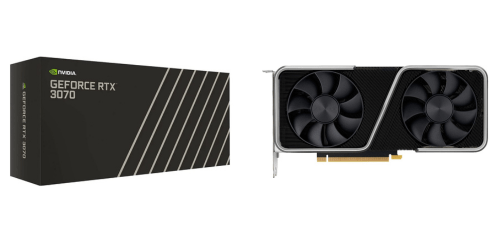
Why Do I Recommend The GeForce RTX 3070?
- The GeForce RTX 3070 has 5888 CUDA cores to deliver higher raw shader throughput for smoother frame rates in demanding modern games, while the GeForce RTX 3060 Ti uses 4864 CUDA cores.
- GeForce RTX 3070 features higher boost clock speeds to maintain stronger sustained performance during long gaming or rendering sessions, whereas the GeForce RTX 3060 Ti runs at lower boost frequencies.
- It includes more RT cores to handle real-time ray tracing effects with less performance drop in supported titles, while the GeForce RTX 3060 Ti has fewer RT cores.
- The GeForce RTX 3070 comes with a higher total graphics power budget to sustain peak performance under heavy workloads, whereas the GeForce RTX 3060 Ti operates with a lower power limit.
- GeForce RTX 3070 has more texture units to improve texture filtering and detail rendering at higher resolutions, while the GeForce RTX 3060 Ti has fewer texture units.
- It includes more ROPs to achieve higher pixel fill rates for better performance at high resolutions, while the GeForce RTX 3060 Ti uses fewer ROPs.
- The GeForce RTX 3070 supports higher performance headroom for 4K gaming with more stable frame delivery, whereas the GeForce RTX 3060 Ti is more constrained at 4K resolutions.
- GeForce RTX 3070 features stronger overall compute performance to better handle GPU-accelerated creative workloads and advanced game engines, while the GeForce RTX 3060 Ti delivers lower compute throughput.
Maybe the GeForce RTX 3060 Ti price can make you comfortable because it’s a little bit cheaper than the GeForce RTX 3070. But you have to compromise all the above-mentioned features. Now the Decision is Yours. I hope it was helpful to choose the right one.
Side By Side Comparison
| Feature | GeForce RTX 3070 | GeForce RTX 3060 Ti |
| Architecture | Ampere GA104-300 | Ampere GA104-200 |
| CUDA Cores | 5888 | 4864 |
| RT Cores | 46 | 38 |
| Tensor Cores | 184 | 152 |
| Base Clock | 1500 MHz | 1410 MHz |
| Boost Clock | 1725 MHz | 1665 MHz |
| Texture Units | 184 | 152 |
| ROPs | 96 | 80 |
| FP32 Throughput | Higher | Lower |
| Memory Interface | 256-bit | 256-bit |
| Memory Bandwidth | 448 GB/s | 448 GB/s |
| Total Graphics Power | 220 W | 200 W |
| Recommended PSU | 650 W | 600 W |
| PCIe Power Connectors | 1×12-pin or 2×8-pin | 1×8-pin |
| Price | Check RTX 3070 Price | Check RTX 3060 Ti Price |
What Common Both Can Do?
- Architecture: Both graphics cards are built on NVIDIA’s Ampere architecture, which introduced major efficiency and performance improvements over previous generations. This ensures support for modern rendering techniques and consistent performance behavior across games and applications.
- GPU Die: Each model uses the GA104 GPU die, meaning they share the same core silicon design. This results in similar architectural capabilities and feature support despite differences in enabled cores.
- Manufacturing Process: Both GPUs are manufactured using Samsung’s 8nm process. This affects power efficiency, thermal behavior, and overall scalability in compact or airflow-limited systems.
- Ray Tracing Support: Both cards support real-time ray tracing through dedicated RT cores. This allows realistic lighting, shadows, and reflections in supported games.
- DLSS Support: Each GPU supports Deep Learning Super Sampling, enabling higher frame rates by upscaling lower-resolution images using AI. This is especially useful for maintaining smooth performance with ray tracing enabled.
- Tensor Core Generation: Both models use third-generation Tensor cores. These cores accelerate AI-based tasks such as DLSS and certain productivity workloads.
- RT Core Generation: Second-generation RT cores are present in both GPUs. These improve ray traversal and intersection calculations compared to earlier designs.
- VRAM Capacity: Each card includes 8 GB of video memory. This capacity is sufficient for most modern games at 1440p resolution and common creative workloads.
- VRAM Type: Both GPUs use GDDR6 memory. This provides a good balance of speed, efficiency, and thermal performance.
- Memory Interface: A 256-bit memory bus is shared by both models. This contributes to identical memory bandwidth and similar performance behavior in memory-sensitive tasks.
- Memory Speed: Both graphics cards run memory at 14 Gbps. This ensures equal data transfer rates between the GPU and VRAM.
- Memory Bandwidth: Each model delivers 448 GB/s of memory bandwidth. This helps maintain performance in high-resolution textures and complex scenes.
- PCI Express Interface: Both cards use a PCIe 4.0 x16 interface. This ensures full compatibility with modern motherboards and high-bandwidth data transfer.
- Max Display Outputs: Each GPU can drive up to four displays simultaneously. This is useful for multi-monitor gaming and productivity setups.
- HDMI Support: HDMI 2.1 is supported on both cards. This enables high refresh rate 4K output and compatibility with next-generation displays and TVs.
- DisplayPort Support: Both GPUs include DisplayPort 1.4a. This supports high-resolution, high-refresh-rate monitors with features like DSC.
- NVENC Encoder: Hardware video encoding is available on both models. This is important for streaming, recording gameplay, and video production.
- NVDEC Decoder: Both GPUs include hardware video decoding. This allows efficient playback of high-resolution video formats with low CPU usage.
- G-SYNC Support: Each card supports NVIDIA G-SYNC technology. This reduces screen tearing and improves visual smoothness during gaming.
- DirectX Support: Both GPUs support DirectX 12 Ultimate. This ensures compatibility with the latest graphics features used in modern games.
- Vulkan Support: Vulkan API support is present on both models. This allows optimized performance in games and applications that use low-level graphics APIs.
Common Features
| Feature | GeForce RTX 3070 | GeForce RTX 3060 Ti |
| Architecture | Ampere | Ampere |
| GPU Die | GA104 | GA104 |
| Manufacturing Process | Samsung 8nm | Samsung 8nm |
| Ray Tracing Support | Yes | Yes |
| DLSS Support | Yes | Yes |
| Tensor Core Generation | 3rd Gen | 3rd Gen |
| RT Core Generation | 2nd Gen | 2nd Gen |
| VRAM Capacity | 8 GB | 8 GB |
| VRAM Type | GDDR6 | GDDR6 |
| Memory Interface | 256-bit | 256-bit |
| Memory Speed | 14 Gbps | 14 Gbps |
| Memory Bandwidth | 448 GB/s | 448 GB/s |
| PCI Express Interface | PCIe 4.0 x16 | PCIe 4.0 x16 |
| Max Display Outputs | 4 | 4 |
| HDMI Support | HDMI 2.1 | HDMI 2.1 |
| DisplayPort Support | DisplayPort 1.4a | DisplayPort 1.4a |
| NVENC Encoder | Yes | Yes |
| NVDEC Decoder | Yes | Yes |
| G-SYNC Support | Yes | Yes |
| DirectX Support | DirectX 12 Ultimate | DirectX 12 Ultimate |
| Vulkan Support | Yes | Yes |
| Price | Check RTX 3070 Price | Check RTX 3060 Ti Price |