GeForce RTX 4060 Ti & Radeon RX 7600 share many similarities, but there are also important differences, such as quality, performance, features, design, and connectivity. If you want the best one between them, I Would recommend the GeForce RTX 4060 Ti rather than the Radeon RX 7600.
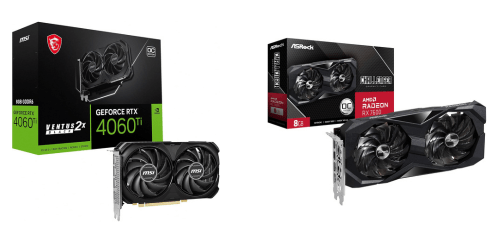
Why Do I Recommend The GeForce RTX 4060 Ti?
- The GeForce RTX 4060 Ti comes with DLSS 3 Frame Generation to significantly increase frame rates in supported games while maintaining smooth motion, while the Radeon RX 7600 uses FSR upscaling without AI-based frame generation.
- GeForce RTX 4060 Ti features dedicated Tensor Cores for accelerating AI workloads and advanced upscaling tasks, whereas the Radeon RX 7600 relies on general-purpose compute units without specialized AI hardware.
- It has stronger dedicated ray tracing cores to deliver more stable lighting, reflections, and shadows in ray-traced games, while the Radeon RX 7600 uses ray accelerators with lower ray tracing throughput.
- The GeForce RTX 4060 Ti includes NVENC hardware encoding to provide higher-quality game streaming and video recording with lower CPU usage, whereas the Radeon RX 7600 uses a less widely optimized AMD media encoder.
- GeForce RTX 4060 Ti supports a broader CUDA software ecosystem to improve performance and compatibility in professional applications and creative tools, while the Radeon RX 7600 uses ROCm-based acceleration with more limited software adoption.
- It comes with more mature driver optimizations for new game releases to deliver consistent launch-day performance, whereas the Radeon RX 7600 often depends more heavily on post-launch driver tuning.
- The GeForce RTX 4060 Ti features better performance efficiency in ray-traced workloads to maintain higher frame rates at similar power levels, while the Radeon RX 7600 prioritizes raster performance.
- GeForce RTX 4060 Ti supports a wider range of DLSS-enabled titles to achieve higher visual quality at lower render resolutions, while the Radeon RX 7600 depends on FSR support.
Maybe the Radeon RX 7600 price can make you comfortable because it’s a little bit cheaper than the GeForce RTX 4060 Ti. But you have to compromise all the above-mentioned features. Now the Decision is Yours. I hope it was helpful to choose the right one.
Side By Side Comparison
| Feature | GeForce RTX 4060 Ti | Radeon RX 7600 |
| GPU architecture | Ada Lovelace | RDNA 3 |
| GPU chip | AD106 | Navi 33 |
| Process node | TSMC 4N | TSMC N6 |
| Shader/core units | 4352 CUDA cores | 2048 stream processors |
| Compute units / SMs | 34 SMs | 32 CUs |
| Ray tracing hardware | 34 RT cores | 32 ray accelerators |
| AI hardware | 136 Tensor cores | 64 AI accelerators |
| Base clock | 2310 MHz | 1720 MHz |
| VRAM options | 8GB / 16GB GDDR6 | 8GB GDDR6 |
| Frame generation | DLSS 3 Frame Generation | FSR 3 Frame Generation |
| Ray tracing performance focus | RT cores + DLSS path | Ray accelerators + FSR path |
| Creator acceleration platform | CUDA | ROCm / HIP |
| Video encoder branding | NVENC | AMD Media Engine |
| DisplayPort standard | DisplayPort 1.4a | DisplayPort 2.1 |
| Price | Check 4060 Ti Price | Check RX 7600 Price |
What Common Both Can Do?
- Desktop GPU class: Both graphics cards are designed specifically for desktop PC systems, ensuring compatibility with standard ATX and micro-ATX builds. This makes them suitable for mainstream gaming and productivity desktops rather than mobile or low-power environments.
- Target resolution: Both GPUs are aimed at 1080p and entry-level 1440p gaming, where they deliver smooth performance in modern titles. This shared focus makes them ideal for gamers using high-refresh-rate Full HD or standard QHD monitors.
- Manufacturing process: Each card is produced using TSMC fabrication technology, which helps deliver modern efficiency and performance characteristics. This contributes to stable power behavior and consistent thermal performance.
- PCI Express generation: Both models support PCIe 4.0, enabling high-speed data transfer between the GPU and the CPU. This ensures compatibility with modern motherboards and minimizes bandwidth limitations in current systems.
- VRAM type: Both graphics cards use GDDR6 memory, which provides fast data access for textures and frame buffers. This memory type is well suited for modern gaming workloads and content creation tasks.
- VRAM capacity (common models): Each GPU commonly ships with 8 GB of video memory, which is sufficient for most 1080p and many 1440p gaming scenarios. This allows users to run modern games with high texture settings in typical use cases.
- Memory bus width: Both cards use a 128-bit memory bus, balancing bandwidth with power efficiency. This design choice supports mainstream performance targets while keeping power consumption under control.
- DirectX support: Each GPU supports DirectX 12 Ultimate, ensuring compatibility with the latest graphics features used by modern game engines. This includes advanced rendering techniques and future-proof API support.
- Hardware ray tracing: Both GPUs include dedicated hardware for ray tracing, allowing games to render realistic lighting, reflections, and shadows. This enables users to experience modern visual effects without relying solely on software rendering.
- Variable Rate Shading: Both cards support Variable Rate Shading, which allows the GPU to allocate rendering resources more efficiently. This improves performance by reducing detail in less noticeable areas of the screen.
- AV1 decode support: Each GPU can decode AV1 video streams, improving efficiency and quality when watching modern high-resolution online video. This is particularly useful for streaming platforms that adopt newer codecs.
- Modern video encoders: Both graphics cards include up-to-date video encoding hardware, making them suitable for game capture, video recording, and basic streaming. This allows users to create content without heavily taxing the CPU.
- HDMI output: Both GPUs feature HDMI 2.1 support, enabling high refresh rates and resolutions on modern TVs and monitors. This is especially useful for gamers using large displays or living-room setups.
- DisplayPort output: Each card includes DisplayPort connectivity, ensuring compatibility with a wide range of gaming and professional monitors. This allows flexible multi-display configurations.
- Multi-monitor support: Both GPUs can drive multiple displays simultaneously, making them suitable for productivity setups and immersive gaming environments. This helps users expand their workspace or gaming field of view.
- Driver-level sharpening: Each GPU ecosystem includes driver-based image sharpening features, allowing users to improve perceived image clarity. This can enhance visual sharpness with minimal performance impact.
- Image upscaling support: Both cards support modern upscaling technologies, enabling higher perceived resolution without rendering every pixel natively. This helps maintain smoother frame rates in demanding games.
- Smart power management: Both GPUs use intelligent power management systems to balance performance and efficiency. This helps reduce unnecessary power draw during lighter workloads and improves overall system stability.
Common Features
| Feature | GeForce RTX 4060 Ti | Radeon RX 7600 |
| Desktop GPU class | Yes | Yes |
| Target resolution | 1080p / 1440p | 1080p / 1440p |
| Manufacturing process | TSMC | TSMC |
| PCI Express generation | PCIe 4.0 | PCIe 4.0 |
| VRAM type | GDDR6 | GDDR6 |
| VRAM capacity (common models) | 8 GB | 8 GB |
| Memory bus width | 128-bit | 128-bit |
| DirectX support | DirectX 12 Ultimate | DirectX 12 Ultimate |
| Hardware ray tracing | Yes | Yes |
| Variable Rate Shading | Yes | Yes |
| AV1 decode support | Yes | Yes |
| Modern video encoders | Yes | Yes |
| HDMI output | HDMI 2.1 | HDMI 2.1 |
| DisplayPort output | DisplayPort | DisplayPort |
| Multi-monitor support | Yes | Yes |
| Driver-level sharpening | Yes | Yes |
| Image upscaling support | Yes | Yes |
| Smart power management | Yes | Yes |
| Price | Check 4060 Ti Price | Check RX 7600 Price |