GeForce RTX 4070 Ti & GeForce RTX 3080 share many similarities, but there are also important differences, such as quality, performance, features, design, and connectivity. If you want the best one between them, I Would recommend the GeForce RTX 4070 Ti rather than the GeForce RTX 3080.
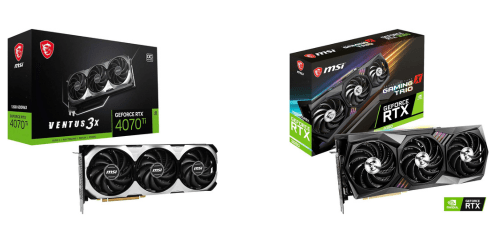
Why Do I Recommend The GeForce RTX 4070 Ti?
- The GeForce RTX 4070 Ti features Ada Lovelace architecture for higher performance per watt and improved efficiency in modern games and creative workloads, while the GeForce RTX 3080 uses the Ampere architecture.
- GeForce RTX 4070 Ti supports DLSS 3 with frame generation to significantly increase frame rates in supported titles with minimal image quality loss, whereas the GeForce RTX 3080 supports DLSS 2 without frame generation.
- It comes with 4th-generation Tensor Cores for faster AI upscaling, improved image reconstruction, and stronger performance in AI-accelerated applications, while the GeForce RTX 3080 uses 3rd-generation Tensor Cores.
- The GeForce RTX 4070 Ti includes 3rd-generation Ray Tracing Cores for more efficient real-time lighting, shadows, and reflections in ray-traced games, whereas the GeForce RTX 3080 relies on 2nd-generation Ray Tracing Cores.
- GeForce RTX 4070 Ti has a much larger L2 cache to reduce memory latency and improve performance consistency at higher resolutions, while the GeForce RTX 3080 has a significantly smaller L2 cache.
- It uses a lower typical board power to deliver strong gaming performance with reduced heat output and lower power supply requirements, while the GeForce RTX 3080 draws substantially more power.
- The GeForce RTX 4070 Ti supports AV1 hardware encoding to produce higher-quality streams and recordings at lower bitrates, whereas the GeForce RTX 3080 lacks native AV1 encoding support.
- GeForce RTX 4070 Ti achieves much higher boost clock speeds for faster single-threaded and lightly parallel workloads in games and applications, while the GeForce RTX 3080 runs at lower clock frequencies.
Maybe the GeForce RTX 3080 price can make you comfortable because it’s a little bit cheaper than the GeForce RTX 4070 Ti. But you have to compromise all the above-mentioned features. Now the Decision is Yours. I hope it was helpful to choose the right one.
Side By Side Comparison
| Feature | GeForce RTX 4070 Ti | GeForce RTX 3080 |
| GPU Architecture | Ada Lovelace | Ampere |
| Manufacturing Node | TSMC 4N | Samsung 8nm |
| Base Clock | 2.31 GHz | 1.44 GHz |
| Boost Clock | 2.61 GHz | 1.71 GHz |
| Tensor Cores | 4th Gen | 3rd Gen |
| Ray Tracing Cores | 3rd Gen | 2nd Gen |
| DLSS Support | DLSS 3 | DLSS 2 |
| Frame Generation | Yes | No |
| VRAM Capacity | 12 GB | 10 GB |
| L2 Cache | 48 MB | 5 MB |
| Typical Board Power | 285 W | 320 W |
| Power Connector | 16-pin 12VHPWR | Dual 8-pin |
| AV1 Encode | Supported | Not Supported |
| HDMI Version | HDMI 2.1a | HDMI 2.1 |
| Transistor Density | Higher | Lower |
| Performance per Watt | Higher | Lower |
| Price | Check 4070 Ti Price | Check RTX 3080 Price |
What Common Both Can Do?
- NVIDIA GeForce RTX Branding: Both graphics cards belong to NVIDIA’s GeForce RTX lineup, ensuring access to the same ecosystem of drivers, software optimizations, and long-term platform support.
- PCIe Interface: Both GPUs use a PCIe 4.0 x16 interface, allowing high-bandwidth communication with modern motherboards and ensuring compatibility with current gaming and workstation systems.
- DirectX Support: Both models support DirectX 12 Ultimate, enabling advanced graphics features such as ray tracing, variable rate shading, and mesh shaders in supported games.
- Vulkan Support: Each GPU supports the Vulkan API, providing efficient low-level access for games and professional applications that rely on cross-platform graphics rendering.
- Ray Tracing Support: Both graphics cards support hardware-accelerated ray tracing, allowing realistic lighting, shadows, and reflections in compatible games and applications.
- DLSS Support: Both GPUs support NVIDIA DLSS technology, enabling AI-assisted image upscaling to improve performance while maintaining visual quality.
- GDDR6X Memory Type: Each model uses GDDR6X memory, which delivers high-speed data transfer suitable for high-resolution gaming and demanding workloads.
- Hardware Ray Tracing: Both cards include dedicated ray tracing hardware, ensuring consistent ray-traced performance without relying solely on traditional shader cores.
- NVIDIA Reflex: Both GPUs support NVIDIA Reflex, which helps reduce system latency in competitive games for more responsive gameplay.
- NVIDIA Broadcast: Each card supports NVIDIA Broadcast features, including noise removal, background blur, and virtual backgrounds for streaming and video calls.
- NVIDIA Studio Drivers: Both GPUs are compatible with NVIDIA Studio drivers, offering optimized performance and stability for creative and professional software.
- VR Ready: Both models are VR-ready, providing the performance and feature support required for modern virtual reality headsets.
- Multi-Monitor Support: Each GPU supports multiple displays, making them suitable for productivity setups and immersive gaming environments.
- HDMI Output: Both cards include HDMI 2.1 support, enabling high refresh rate gaming and high-resolution output on compatible displays.
- DisplayPort Output: Both GPUs support DisplayPort 1.4a, allowing high-resolution and high-refresh-rate monitors to be used effectively.
- Ansel Support: Each card supports NVIDIA Ansel, enabling advanced in-game photography features for capturing high-quality screenshots.
- ShadowPlay: Both GPUs support NVIDIA ShadowPlay, allowing users to record gameplay footage and capture highlights with minimal performance impact.
Common Features
| Feature | GeForce RTX 4070 Ti | GeForce RTX 3080 |
| NVIDIA GeForce RTX Branding | Yes | Yes |
| PCIe Interface | PCIe 4.0 x16 | PCIe 4.0 x16 |
| DirectX Support | DirectX 12 Ultimate | DirectX 12 Ultimate |
| Vulkan Support | Yes | Yes |
| Ray Tracing Support | Yes | Yes |
| DLSS Support | Yes | Yes |
| GDDR6X Memory Type | Yes | Yes |
| Hardware Ray Tracing | Yes | Yes |
| NVIDIA Reflex | Yes | Yes |
| NVIDIA Broadcast | Yes | Yes |
| NVIDIA Studio Drivers | Yes | Yes |
| VR Ready | Yes | Yes |
| Multi-Monitor Support | Yes | Yes |
| HDMI Output | HDMI 2.1 | HDMI 2.1 |
| DisplayPort Output | DisplayPort 1.4a | DisplayPort 1.4a |
| Ansel Support | Yes | Yes |
| ShadowPlay | Yes | Yes |
| Price | Check 4070 Ti Price | Check RTX 3080 Price |