GeForce RTX 4080 & GeForce RTX 4070 Ti share many similarities, but there are also important differences, such as quality, performance, features, design, and connectivity. If you want the best one between them, I Would recommend the GeForce RTX 4080 rather than the GeForce RTX 4070 Ti.
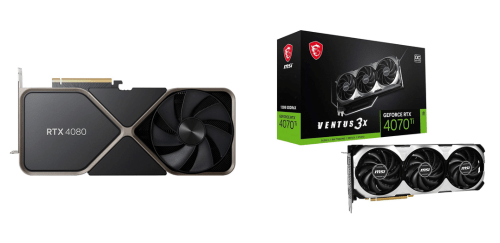
Why Do I Recommend The GeForce RTX 4080?
- The GeForce RTX 4080 has a larger AD103 GPU die for higher overall compute throughput in demanding games and creative workloads, while the GeForce RTX 4070 Ti uses the smaller AD104 GPU die.
- GeForce RTX 4080 comes with 9728 CUDA cores to deliver stronger rasterization performance and higher frame rates at high resolutions, whereas the GeForce RTX 4070 Ti has 7680 CUDA cores.
- It features 16 GB GDDR6X memory to handle modern games and professional applications with higher VRAM requirements, while the GeForce RTX 4070 Ti comes with 12 GB GDDR6X memory.
- The GeForce RTX 4080 includes a 256-bit memory bus for significantly higher memory bandwidth in 4K gaming and heavy texture workloads, whereas the GeForce RTX 4070 Ti uses a narrower 192-bit memory bus.
- GeForce RTX 4080 has 76 RT cores for smoother and more consistent ray-traced lighting and reflections at higher resolutions, while the GeForce RTX 4070 Ti includes 60 RT cores.
- It comes with 304 Tensor cores to improve DLSS frame generation stability and AI-assisted rendering performance, whereas the GeForce RTX 4070 Ti has 240 Tensor cores.
- The GeForce RTX 4080 includes dual NVENC encoders for faster video encoding and more efficient high-quality streaming, while the GeForce RTX 4070 Ti uses a single NVENC encoder.
- GeForce RTX 4080 supports higher sustained performance under heavy loads due to its higher total graphics power headroom, while the GeForce RTX 4070 Ti is designed for lower overall power consumption.
Maybe the GeForce RTX 4070 Ti price can make you comfortable because it’s a little bit cheaper than the GeForce RTX 4080. But you have to compromise all the above-mentioned features. Now the Decision is Yours. I hope it was helpful to choose the right one.
Side By Side Comparison
| Feature | GeForce RTX 4080 | GeForce RTX 4070 Ti |
| Transistor Count | Higher | Lower |
| Die Size | Larger | Smaller |
| CUDA Cores | 9728 | 7680 |
| SM Count | 76 | 60 |
| RT Cores | 76 | 60 |
| Tensor Cores | 304 | 240 |
| VRAM Capacity | 16 GB | 12 GB |
| Memory Bus Width | 256-bit | 192-bit |
| Memory Bandwidth | 716.8 GB/s | 504.2 GB/s |
| L2 Cache | 64 MB | 48 MB |
| FP32 Compute | Higher | Lower |
| Ray Tracing Throughput | Higher | Lower |
| Tensor Throughput | Higher | Lower |
| NVENC Encoders | Dual | Single |
| Total Graphics Power | 320 W | 285 W |
| Recommended PSU | 750 W | 700 W |
| Board Power Headroom | Higher | Lower |
| Price | Check RTX 4080 Price | Check RTX 4070 Ti Price |
What Common Both Can Do?
- GPU Architecture: Both graphics cards are based on NVIDIA’s Ada Lovelace architecture. This shared design brings improved efficiency, higher IPC, and modern feature support across gaming and professional workloads.
- Manufacturing Process: Each GPU is built on TSMC’s custom 4N process. This enables better power efficiency and higher transistor density compared to previous generations.
- PCIe Interface: Both models use a PCIe 4.0 x16 interface. This ensures full compatibility with modern motherboards and provides ample bandwidth for current and near-future gaming needs.
- DirectX Support: Both support DirectX 12 Ultimate. This allows access to advanced graphics features such as hardware ray tracing, mesh shaders, and variable rate shading.
- Vulkan Support: Vulkan 1.3 support is present on both GPUs. This benefits cross-platform games and applications that rely on low-level graphics APIs for improved performance.
- Ray Tracing Support: Each graphics card includes dedicated RT cores. This enables realistic lighting, reflections, and shadows in supported games and rendering applications.
- DLSS Support: Both GPUs support DLSS 3 technology. This allows AI-assisted upscaling to improve performance while maintaining high image quality.
- Frame Generation: Frame Generation is supported on both models. This feature uses AI to generate additional frames, resulting in smoother gameplay at higher frame rates.
- NVIDIA Reflex: Both graphics cards include NVIDIA Reflex support. This helps reduce system latency, which is especially important for competitive gaming.
- AV1 Decode: AV1 video decoding is available on both GPUs. This allows efficient playback of modern high-quality video streams with reduced CPU usage.
- AV1 Encode: Both models support AV1 hardware encoding. This benefits streamers and content creators by providing better compression efficiency and video quality.
- HDMI Version: HDMI 2.1a is supported on both cards. This enables high refresh rate gaming at 4K and support for modern TVs and monitors.
- DisplayPort Version: Each GPU includes DisplayPort 1.4a support. This allows high-resolution and high-refresh-rate displays to be used without compatibility issues.
- Max Digital Resolution: Both GPUs support resolutions up to 8K. This makes them suitable for advanced display setups and professional visualization tasks.
- Multi-Monitor Support: Multi-monitor configurations are supported on both models. Users can run several displays simultaneously for productivity or immersive gaming setups.
- NVIDIA G-SYNC: Both graphics cards support NVIDIA G-SYNC. This technology synchronizes the display refresh rate with GPU output to reduce screen tearing and stutter.
- VR Ready: Each model is VR ready. This ensures compatibility with modern VR headsets and smooth performance in virtual reality applications.
- OpenGL Support: OpenGL 4.6 support is included on both GPUs. This maintains compatibility with a wide range of professional and legacy graphics applications.
Common Features
| Feature | GeForce RTX 4080 | GeForce RTX 4070 Ti |
| GPU Architecture | Ada Lovelace | Ada Lovelace |
| Manufacturing Process | 4N | 4N |
| PCIe Interface | PCIe 4.0 x16 | PCIe 4.0 x16 |
| DirectX Support | DirectX 12 Ultimate | DirectX 12 Ultimate |
| Vulkan Support | Vulkan 1.3 | Vulkan 1.3 |
| Ray Tracing Support | Yes | Yes |
| DLSS Support | DLSS 3 | DLSS 3 |
| Frame Generation | Yes | Yes |
| NVIDIA Reflex | Yes | Yes |
| AV1 Decode | Yes | Yes |
| AV1 Encode | Yes | Yes |
| HDMI Version | HDMI 2.1a | HDMI 2.1a |
| DisplayPort Version | DisplayPort 1.4a | DisplayPort 1.4a |
| Max Digital Resolution | 7680×4320 | 7680×4320 |
| Multi-Monitor Support | Yes | Yes |
| NVIDIA G-SYNC | Yes | Yes |
| VR Ready | Yes | Yes |
| OpenGL Support | OpenGL 4.6 | OpenGL 4.6 |
| Price | Check RTX 4080 Price | Check RTX 4070 Ti Price |