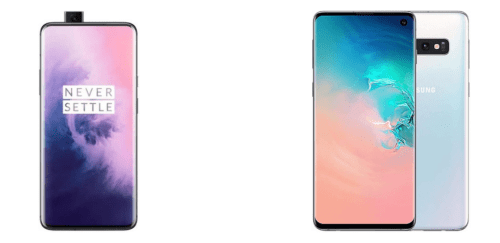
OnePlus 7 Pro & Samsung Galaxy S10 share many similarities, but there are also important differences, such as quality, performance, features, design, and connectivity. If you want the best one between them, I Would recommend the OnePlus 7 Pro rather than the Samsung Galaxy S10.
Why Do I Recommend The OnePlus 7 Pro?
- The OnePlus 7 Pro features a 90 Hz Fluid AMOLED display for smoother scrolling, gaming, and UI animations during daily use, while the Samsung Galaxy S10 uses a 60 Hz Dynamic AMOLED display.
- OnePlus 7 Pro comes with a 6.67-inch edge-to-edge display for a more immersive viewing experience when watching videos or reading content, whereas the Samsung Galaxy S10 uses a smaller 6.1-inch display with a punch-hole cutout.
- It includes a motorized pop-up front camera to provide an uninterrupted full-screen experience during gaming and media playback, while the Samsung Galaxy S10 uses a fixed punch-hole front camera.
- The OnePlus 7 Pro supports Warp Charge 30 wired charging to significantly reduce charging time during short power top-ups, while the Samsung Galaxy S10 uses 15 W wired fast charging.
- OnePlus 7 Pro has a larger 4000 mAh battery for longer screen-on time during heavy usage days, whereas the Samsung Galaxy S10 comes with a smaller 3400 mAh battery.
- It features a higher-resolution 3120×1440 QHD+ display for sharper text and finer visual detail, while the Samsung Galaxy S10 uses a slightly lower 3040×1440 resolution.
- The OnePlus 7 Pro includes a 3× optical telephoto camera to capture clearer distant subjects without digital degradation, whereas the Samsung Galaxy S10 relies on a 2× optical telephoto lens.
- OnePlus 7 Pro runs OxygenOS to deliver a cleaner interface with faster animations and fewer background services, while the Samsung Galaxy S10 uses One UI with heavier system customization.
Maybe the Samsung Galaxy S10 price can make you comfortable because it’s a little bit cheaper than the OnePlus 7 Pro. But you have to compromise all the above-mentioned features. Now the Decision is Yours. I hope it was helpful to choose the right one.
Side By Side Comparison
| Feature | OnePlus 7 Pro | Samsung Galaxy S10 |
| Display Size | 6.67-inch | 6.1-inch |
| Display Type | Fluid AMOLED | Dynamic AMOLED |
| Refresh Rate | 90 Hz | 60 Hz |
| Screen Design | Full screen | Punch-hole |
| Screen Curvature | Curved edges | Flat |
| Resolution | 3120×1440 | 3040×1440 |
| Front Camera Mechanism | Motorized pop-up | Fixed |
| Front Camera Resolution | 16 MP | 10 MP |
| Rear Camera Main Sensor | 48 MP | 12 MP |
| Telephoto Zoom | 3× optical | 2× optical |
| Video Stabilization Mode | Standard | Super Steady |
| Battery Capacity | 4000 mAh | 3400 mAh |
| Wired Charging Speed | 30 W | 15 W |
| Device Weight | 206 g | 157 g |
| Body Thickness | 8.8 mm | 7.8 mm |
| Software Interface | OxygenOS | One UI |
| Color Calibration Style | Neutral | Saturated |
| Price | Check OnePlus 7 Pro Price | Check Samsung S10 Price |
What Common Both Can Do?
- Chipset Series: Both devices are powered by the Snapdragon 855 platform, ensuring strong flagship-level performance for daily tasks, gaming, and multitasking. Using the same chipset results in similar processing efficiency and thermal behavior.
- CPU Architecture: Each phone uses an octa-core processor configuration, balancing high-performance cores with efficiency cores. This setup helps maintain responsiveness while optimizing battery usage during lighter workloads.
- GPU: The Adreno 640 GPU is shared between both models, enabling comparable graphics performance in games and GPU-accelerated apps. Users can expect similar frame rates and visual fidelity across supported titles.
- AMOLED Display: Both phones use AMOLED panel technology, allowing for deep blacks, vibrant colors, and power efficiency. This display type also enables features like Always-On Display and high contrast ratios.
- QHD+ Resolution: Each device features a QHD+ resolution screen, providing sharp text and detailed visuals. This is especially noticeable when viewing high-resolution photos, videos, and web content.
- HDR Support: HDR10 support is available on both phones, improving contrast and color range when viewing compatible video content. This enhances media consumption on supported streaming platforms.
- Always-On Display: Both models support Always-On Display functionality, allowing users to view notifications, time, and icons without fully waking the screen. This adds convenience while maintaining low power usage.
- Triple Rear Cameras: Each smartphone is equipped with a triple-camera setup on the rear, expanding photographic versatility. This allows users to capture standard, zoomed, and wide-angle shots without changing devices.
- Ultra-wide Camera: Both phones include an ultra-wide lens, enabling users to capture broader scenes such as landscapes or group photos. This adds creative flexibility beyond standard photography.
- Telephoto Camera: A dedicated telephoto lens is present on both devices, supporting optical zoom for clearer distant shots. This improves image quality compared to digital-only zooming.
- Optical Image Stabilization: OIS is included in both camera systems, helping reduce blur caused by hand movement. This is particularly useful for low-light photography and video recording.
- 4K Video Recording: Both smartphones support 4K video recording at up to 60 frames per second. This allows for high-resolution, smooth video capture suitable for professional-looking footage.
- In-display Fingerprint: Each device uses an in-display fingerprint sensor for biometric authentication. This keeps the design clean while providing secure and convenient unlocking.
- Face Unlock: Face unlock is available on both models as an alternative biometric option. It offers quick access to the device in situations where fingerprint unlocking may be less convenient.
- USB Type-C: Both phones use a USB Type-C port for charging and data transfer. This ensures compatibility with modern cables and accessories.
- Bluetooth Version: Bluetooth 5.0 is supported on both devices, providing stable wireless connections and improved range for accessories like earbuds and smartwatches.
- NFC: NFC functionality is present on both phones, enabling contactless payments and quick pairing with compatible devices. This adds everyday convenience for supported services.
- Fast Charging: Each model supports fast charging, reducing downtime when recharging the battery. This is especially useful for users who need quick top-ups during busy days.
Common Features
| Feature | OnePlus 7 Pro | Samsung Galaxy S10 |
| Chipset Series | Snapdragon 855 | Snapdragon 855 |
| CPU Architecture | Octa-core | Octa-core |
| GPU | Adreno 640 | Adreno 640 |
| AMOLED Display | Yes | Yes |
| QHD+ Resolution | Yes | Yes |
| HDR Support | HDR10 | HDR10 |
| Always-On Display | Yes | Yes |
| Triple Rear Cameras | Yes | Yes |
| Ultra-wide Camera | Yes | Yes |
| Telephoto Camera | Yes | Yes |
| Optical Image Stabilization | Yes | Yes |
| 4K Video Recording | 60 fps | 60 fps |
| In-display Fingerprint | Yes | Yes |
| Face Unlock | Yes | Yes |
| USB Type-C | Yes | Yes |
| Bluetooth Version | 5.0 | 5.0 |
| NFC | Yes | Yes |
| Fast Charging | Yes | Yes |
| Price | Check OnePlus 7 Pro Price | Check Samsung S10 Price |