Radeon RX 7700 XT vs 7800 XT – Check Which One Is Best & Why?

Radeon RX 7800 XT & Radeon RX 7700 XT share many similarities, but there are also important differences, such as quality, performance, features, design, and connectivity. If you want the best one between them, I Would recommend the Radeon RX 7800 XT rather than the Radeon RX 7700 XT. 
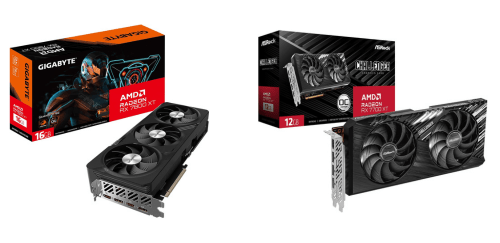
Why Do I Recommend The Radeon RX 7800 XT

  • The Radeon RX 7800 XT has 60 compute units for higher parallel processing throughput and smoother performance in demanding games, while the Radeon RX 7700 XT has 54 compute units.
  • The Radeon RX 7800 XT comes with 3840 stream processors to deliver stronger rasterization performance and higher average frame rates at the same settings, whereas the Radeon RX 7700 XT uses 3456 stream processors.
  • The Radeon RX 7800 XT features 16GB of GDDR6 VRAM for handling large texture packs, open-world assets, and future game requirements without memory bottlenecks, compared to the Radeon RX 7700 XT which comes with 12GB of GDDR6 VRAM.
  • The Radeon RX 7800 XT includes a 256-bit memory bus to provide substantially higher memory throughput for bandwidth-heavy workloads, while the Radeon RX 7700 XT uses a narrower 192-bit memory bus.
  • The Radeon RX 7800 XT supports approximately 624 GB/s of memory bandwidth for more stable performance at higher resolutions and ultra-quality settings, whereas the Radeon RX 7700 XT supports around 432 GB/s of memory bandwidth.
  • The Radeon RX 7800 XT comes with 64MB of Infinity Cache to reduce memory latency and improve performance consistency in modern games, compared to the Radeon RX 7700 XT which includes 48MB of Infinity Cache.
  • The Radeon RX 7800 XT features more ray accelerators to maintain higher frame rates when ray tracing effects are enabled, while the Radeon RX 7700 XT has fewer ray accelerators.
  • The Radeon RX 7800 XT has stronger 4K gaming capability for maintaining playable frame rates with fewer compromises in visual quality, whereas the Radeon RX 7700 XT is primarily optimized for 1440p gaming.

Maybe the Radeon RX 7700 XT price can make you comfortable because it’s a little bit cheaper than the Radeon RX 7800 XT. But you have to compromise all the above-mentioned features. Now the Decision is Yours. I hope it was helpful to choose the right one.

Side By Side Comparison

FeatureRadeon RX 7800 XTRadeon RX 7700 XT
GPU tierHigher-tierMid-tier
Compute Units (CU)6054
Stream Processors38403456
Ray Accelerators6054
AI Accelerators120108
Memory bus width256-bit192-bit
Memory bandwidth~624 GB/s~432 GB/s
Infinity Cache64MB48MB
Total Board Power (TBP)~263W~245W
PSU recommendationHigher wattageLower wattage
4K gaming focusYesLimited
1440p headroomHigherLower
Large texture handlingStrongerWeaker
Ray tracing throughputHigherLower
Bandwidth-bound workloadsBetterWeaker
Cooling requirementMore demandingLess demanding
Typical card sizeLargerSmaller
Case airflow needHigherLower
Power connector loadHigherLower
MSRP classHigherLower
PriceCheck RX 7800 XT PriceCheck RX 7700 XT Price

What Common Both Can Do?

  • GPU Architecture: Both graphics cards are based on AMD’s RDNA 3 architecture. This shared design brings improved efficiency, modern rendering features, and better performance scaling compared to earlier RDNA generations.
  • Manufacturing Process: Each model uses a chiplet-based design combining 5nm and 6nm process nodes. This approach helps balance performance, power efficiency, and production scalability.
  • Graphics Chip Family: Both GPUs are built on the Navi 32 platform. Sharing the same chip family means they have similar core design principles and feature support.
  • PCIe Interface: The two cards use a PCIe 4.0 x16 interface. This ensures sufficient bandwidth for modern gaming workloads and compatibility with current motherboards.
  • Memory Type: Both models rely on GDDR6 memory. This provides stable, high-speed data access for textures, assets, and real-time rendering tasks.
  • Infinity Cache Support: Each GPU includes Infinity Cache technology. This cache helps reduce memory latency and improves effective bandwidth in many gaming scenarios.
  • Ray Tracing Support: Both cards support hardware-accelerated ray tracing. This enables realistic lighting, reflections, and shadows in supported games.
  • Hardware Ray Accelerators: Each model includes dedicated ray accelerators. These specialized units handle ray-tracing calculations more efficiently than general-purpose shaders.
  • AI Accelerators: Both GPUs feature AI accelerators. These are used for tasks such as upscaling, image reconstruction, and future AI-driven graphics features.
  • AMD FidelityFX Super Resolution: Both graphics cards support FSR. This allows games to run at higher frame rates by upscaling from lower internal resolutions with minimal image quality loss.
  • AMD Smart Access Memory: Each card supports Smart Access Memory on compatible systems. This feature allows the CPU to access the full GPU memory, improving performance in some games.
  • DirectX Support: Both GPUs are compatible with DirectX 12 Ultimate. This ensures access to modern graphics features like mesh shaders and advanced ray tracing.
  • Vulkan Support: Vulkan API support is present on both models. This provides broader compatibility with modern and cross-platform games.
  • AV1 Encoding: Each GPU supports AV1 hardware encoding. This is important for efficient game streaming and video creation with lower bitrates.
  • AV1 Decoding: Both cards also support AV1 decoding. This allows smooth playback of high-quality video content from modern streaming platforms.
  • DisplayPort Standard: DisplayPort 2.1 is supported on both GPUs. This enables very high refresh rates and resolutions on next-generation monitors.
  • HDMI Standard: Both models include HDMI 2.1 support. This allows high-bandwidth output for 4K and beyond, including high refresh rate gaming on TVs.
  • Multi-Monitor Support: Each GPU supports multi-display configurations. This is useful for productivity setups and immersive gaming environments.
  • Variable Rate Shading: Both cards support Variable Rate Shading. This feature improves performance by reducing shading workload in less visually critical areas.

Common Features

FeatureRadeon RX 7800 XTRadeon RX 7700 XT
GPU architectureRDNA 3RDNA 3
Manufacturing process5nm + 6nm chiplet5nm + 6nm chiplet
Graphics chip familyNavi 32Navi 32
PCIe interfacePCIe 4.0 x16PCIe 4.0 x16
Memory typeGDDR6GDDR6
Infinity Cache supportYesYes
Ray tracing supportYesYes
Hardware ray acceleratorsYesYes
AI acceleratorsYesYes
AMD FidelityFX Super ResolutionYesYes
AMD Smart Access MemoryYesYes
DirectX supportDirectX 12 UltimateDirectX 12 Ultimate
Vulkan supportYesYes
AV1 encodingYesYes
AV1 decodingYesYes
DisplayPort standardDisplayPort 2.1DisplayPort 2.1
HDMI standardHDMI 2.1HDMI 2.1
Multi-monitor supportYesYes
Variable Rate ShadingYesYes
Price Check RX 7800 XT Price Check RX 7700 XT Price

FAQ

Is the Radeon RX 7800 XT significantly faster than the Radeon RX 7700 XT?
Yes, the Radeon RX 7800 XT is generally faster due to having more compute units, more stream processors, a wider memory bus, and higher memory bandwidth, which together deliver higher overall gaming performance.

Are both the Radeon RX 7800 XT and Radeon RX 7700 XT suitable for 1440p gaming?
Yes, both GPUs are designed for 1440p gaming and can handle modern titles at high or ultra settings, though the Radeon RX 7800 XT provides more performance headroom.

Can both GPUs handle 4K gaming?
Both can run games at 4K, but the Radeon RX 7800 XT is better suited for consistent 4K performance, while the Radeon RX 7700 XT may require lower settings or upscaling in demanding titles.

Do both cards use the same architecture?
Yes, both GPUs are based on AMD’s RDNA 3 architecture, meaning they share the same core feature set and architectural improvements.

Is there a difference in VRAM capacity between the two GPUs?
Yes, the Radeon RX 7800 XT has 16GB of GDDR6 VRAM, while the Radeon RX 7700 XT comes with 12GB of GDDR6 VRAM.

Does the extra VRAM on the Radeon RX 7800 XT matter for gaming?
The extra VRAM helps in memory-heavy games, higher resolutions, and titles with large texture packs, reducing the chance of performance drops due to memory limits.

Do both GPUs support ray tracing?
Yes, both graphics cards include hardware-accelerated ray tracing support through dedicated ray accelerators.

Is ray tracing performance the same on both cards?
No, the Radeon RX 7800 XT performs better in ray-traced workloads because it has more ray accelerators and higher memory bandwidth.

Do both GPUs support AMD FidelityFX Super Resolution (FSR)?
Yes, both cards support FSR, allowing improved performance through upscaling while maintaining good image quality.

Are the power requirements different between the two GPUs?
Yes, the Radeon RX 7800 XT has a higher total board power and typically requires a slightly stronger power supply than the Radeon RX 7700 XT.

Do both cards support the same display standards?
Yes, both GPUs support DisplayPort 2.1 and HDMI 2.1, enabling high resolutions and high refresh rates on modern monitors and TVs.

Is the Radeon RX 7700 XT more power-efficient than the Radeon RX 7800 XT?
In many scenarios, yes, because it consumes less power overall, though it also delivers lower peak performance.

Do both GPUs support AV1 encoding and decoding?
Yes, both cards include hardware support for AV1 encoding and decoding, which is useful for streaming and video playback.

Are these GPUs compatible with PCIe 4.0 systems?
Yes, both use a PCIe 4.0 x16 interface and are fully compatible with modern PCIe 4.0 motherboards.

Which GPU is better for long-term use and future games?
The Radeon RX 7800 XT is generally the better long-term option due to its higher performance ceiling and larger VRAM capacity, which can be beneficial as future games become more demanding.

Quick Deal Access