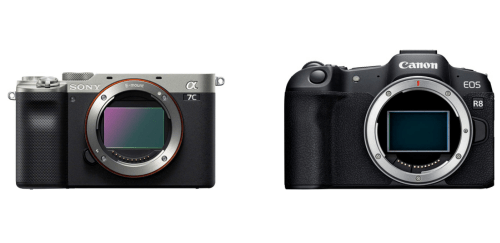
Sony A7C & Canon EOS R8 share many similarities, but there are also important differences, such as quality, performance, features, design, and connectivity. If you want the best one between them, I Would recommend the Sony A7C rather than the Canon EOS R8.
Why Do I Recommend The Sony A7C?
- The Sony A7C comes with 5-axis in-body image stabilization for sharper handheld photos and steadier video with unstabilized lenses, while the Canon R8 uses lens-based or digital stabilization only.
- Sony A7C includes a full mechanical shutter for more reliable shooting under artificial lighting and better flash compatibility, whereas the Canon R8 relies primarily on electronic shutter operation.
- It supports the larger NP-FZ100 battery for significantly longer real-world shooting time during travel and events, while the Canon R8 uses the smaller LP-E17 battery with shorter endurance.
- The Sony A7C features a compact rangefinder-style body for easier packing and discreet street photography, compared to the Canon R8 which uses a more traditional centrally-viewed body layout.
- Sony A7C supports extensive third-party autofocus lens compatibility for more affordable and diverse lens choices, whereas the Canon R8 has more limited third-party autofocus lens availability.
- It comes with built-in sensor stabilization that improves handheld video smoothness without heavy digital cropping, while the Canon R8 depends more on digital stabilization that can reduce field of view.
- The Sony A7C uses a mechanical shutter burst mode for more consistent results with fast-moving subjects under indoor lighting, while the Canon R8 depends on electronic burst modes that can be more light-sensitive.
- Sony A7C features a longer-lasting camera platform with mature firmware and system stability for extended professional use, whereas the Canon R8 is a newer lightweight body designed more for speed and portability.
Maybe the Canon EOS R8 can make you comfortable because it’s a little bit cheaper than the Sony A7C. But you have to compromise all the above-mentioned features. Now the Decision is Yours. I hope it was helpful to choose the right one.
Side-by-Side Comparison
| Feature | Sony A7C | Canon EOS R8 |
| Sensor stabilization | IBIS | No IBIS |
| Shutter type | Mechanical + Electronic | Electronic |
| AF system | Hybrid AF | Dual Pixel CMOS AF II |
| EVF position | Left-corner | Center |
| Battery model | NP-FZ100 | LP-E17 |
| Battery rating | ~740 shots | ~290 shots |
| Log profiles | S-Log3 | C-Log3 |
| Headphone jack | Yes | No |
| Grip style | Compact | Deeper grip feel |
| Mount | Sony E | Canon RF |
| Third-party AF lens support | Broad | Limited |
| Price | Check Sony A7C Price | Check Canon R8 Price |
What Common Both Can Do?
- Full-frame CMOS sensor: Both cameras use a full-frame CMOS sensor, allowing for strong low-light performance and better control over depth of field. This sensor size is ideal for photographers who want high image quality across many shooting scenarios.
- 24MP class resolution: Each model sits in the 24-megapixel range, providing a balance between detail, file size, and processing speed. This resolution works well for both photography and video without overwhelming storage or workflow.
- Interchangeable lens system: Both cameras support interchangeable lenses, giving users flexibility to choose primes, zooms, and specialty lenses. This makes each system adaptable for travel, portraits, landscapes, and video work.
- Mirrorless design: Both use mirrorless construction, resulting in smaller bodies compared to traditional DSLRs. This also enables faster autofocus performance and real-time exposure preview through the EVF.
- Phase-detection autofocus: Each camera relies on on-sensor phase-detection autofocus for fast and accurate focusing. This is especially useful for tracking moving subjects and maintaining focus during continuous shooting.
- Eye detection autofocus: Both models include Eye AF, helping keep subjects’ eyes sharp during portraits. This feature is valuable for both still photography and video with shallow depth of field.
- Face detection autofocus: Face detection is present on both cameras to prioritize human subjects automatically. It simplifies shooting in social, event, and casual photography situations.
- Animal detection autofocus: Each camera supports animal subject detection, improving focus accuracy when photographing pets or wildlife. This reduces missed shots when subjects move unpredictably.
- Continuous autofocus (AF-C): Both cameras allow continuous autofocus tracking while shooting bursts or recording video. This helps maintain focus on moving subjects without manual intervention.
- Electronic shutter: An electronic shutter is available on both models for silent shooting. This is useful in quiet environments such as ceremonies, wildlife photography, or indoor events.
- Mechanical shutter support: Both cameras include mechanical shutter capability for more traditional shooting behavior. This helps reduce rolling shutter and banding in certain lighting conditions.
- Wide ISO range: Each camera provides a broad ISO range, enabling flexibility across bright daylight and low-light scenes. This allows users to maintain usable shutter speeds without excessive noise.
- 4K video recording: Both models are capable of recording 4K video, making them suitable for hybrid shooters. This ensures high detail and modern video standards for content creation.
- Log video profiles: Each camera includes a log gamma profile for video recording. This allows greater dynamic range and flexibility during color grading in post-production.
- Fully articulating touchscreen: Both cameras feature a vari-angle touchscreen that flips and rotates. This design is helpful for vlogging, low-angle shots, and self-recording.
- Electronic viewfinder: An electronic viewfinder is included on both models for eye-level shooting. This provides clear framing and exposure preview even in bright outdoor conditions.
- Single SD card slot (UHS-II): Both cameras use a single UHS-II SD card slot for storage. This supports fast write speeds for high-resolution photos and video recording.
- USB charging and power delivery: Each camera can be charged or powered via USB. This is convenient for travel, long shoots, and power bank usage.
- Wireless connectivity: Wi-Fi and Bluetooth are available on both cameras for image transfer and remote control. This simplifies sharing content and controlling the camera from a smartphone.
- Microphone input: Both models include a microphone input for external audio recording. This improves sound quality for video compared to internal microphones.
- Compact full-frame body: Both cameras are designed to deliver full-frame performance in a relatively compact body. This makes them appealing for travel and everyday carry without sacrificing image quality.
Common Features
| Feature | Sony A7C | Canon EOS R8 |
| Sensor type | Full-frame CMOS | Full-frame CMOS |
| Sensor resolution class | 24MP class | 24MP class |
| Lens mount system | Interchangeable lens | Interchangeable lens |
| Mirrorless design | Yes | Yes |
| Autofocus type | Phase-detection AF | Phase-detection AF |
| Eye detection AF | Yes | Yes |
| Face detection AF | Yes | Yes |
| Animal detection AF | Yes | Yes |
| Continuous AF (AF-C) | Yes | Yes |
| Electronic shutter | Yes | Yes |
| Mechanical shutter support | Yes | Yes |
| ISO range (base/extended) | Wide range | Wide range |
| Video recording | 4K | 4K |
| Log video profile | Yes | Yes |
| Fully articulating screen | Yes | Yes |
| Touchscreen control | Yes | Yes |
| Electronic viewfinder | Yes | Yes |
| EVF resolution class | 2.36M dots | 2.36M dots |
| Single memory card slot | Yes | Yes |
| SD card support | SD | SD |
| USB charging/power | Yes | Yes |
| Wireless connectivity | Wi-Fi + Bluetooth | Wi-Fi + Bluetooth |
| Price | Check Sony A7C Price | Check Canon R8 Price |
FAQ
Is the Sony A7C or Canon EOS R8 better for beginners? Do both the Sony A7C and Canon EOS R8 use full-frame sensors? Are the Sony A7C and Canon EOS R8 good for travel photography? Do both cameras support 4K video recording? Can both cameras shoot silently? Do the Sony A7C and Canon EOS R8 have flip-out screens? Are these cameras suitable for portrait photography? Do both cameras support external microphones? Can the Sony A7C and Canon EOS R8 be used for action photography? Do both cameras have viewfinders? Are the Sony A7C and Canon EOS R8 good for low-light shooting? Do these cameras support wireless connectivity? Can both cameras charge via USB? Are the Sony A7C and Canon EOS R8 hybrid cameras? Is lens availability good for both systems? |